Tinker's Bubble
Tinker’s Bubble Audioscapes
Loading playlist…
The place and its origins
Tinkers Bubble is an intentional community located near Norton Sub Hamdon in south Somerset, England. It was established in 1994 on 42 acres of land consisting of about 28 acres of woodland as well as orchards and pasture. The name derives from the spring that flows through the woodland and ends in a small waterfall by the road - historically, gypsies brought their horses to this “bubble” (the gypsy name for waterfall) to water them.
Meg + Kam, Tinker's Bubble Residents
The community was founded by a group of 10 friends, including former Ecologist editor Simon Fairlie, who shared a vision of a place where people could live and work in harmony with the land. The site comprises approximately 28 acres of managed woodland (mostly Douglas fir and larch but with patches of native species such as ash trees) and 14 acres of orchard and pasture. The woodland provides the fuel for cooking, space and water-heating. A wind-generator and solar panels provide electricity for lighting, music and laptops. Much of the pasture is maintained traditionally using scythes for hay-making.
How it works
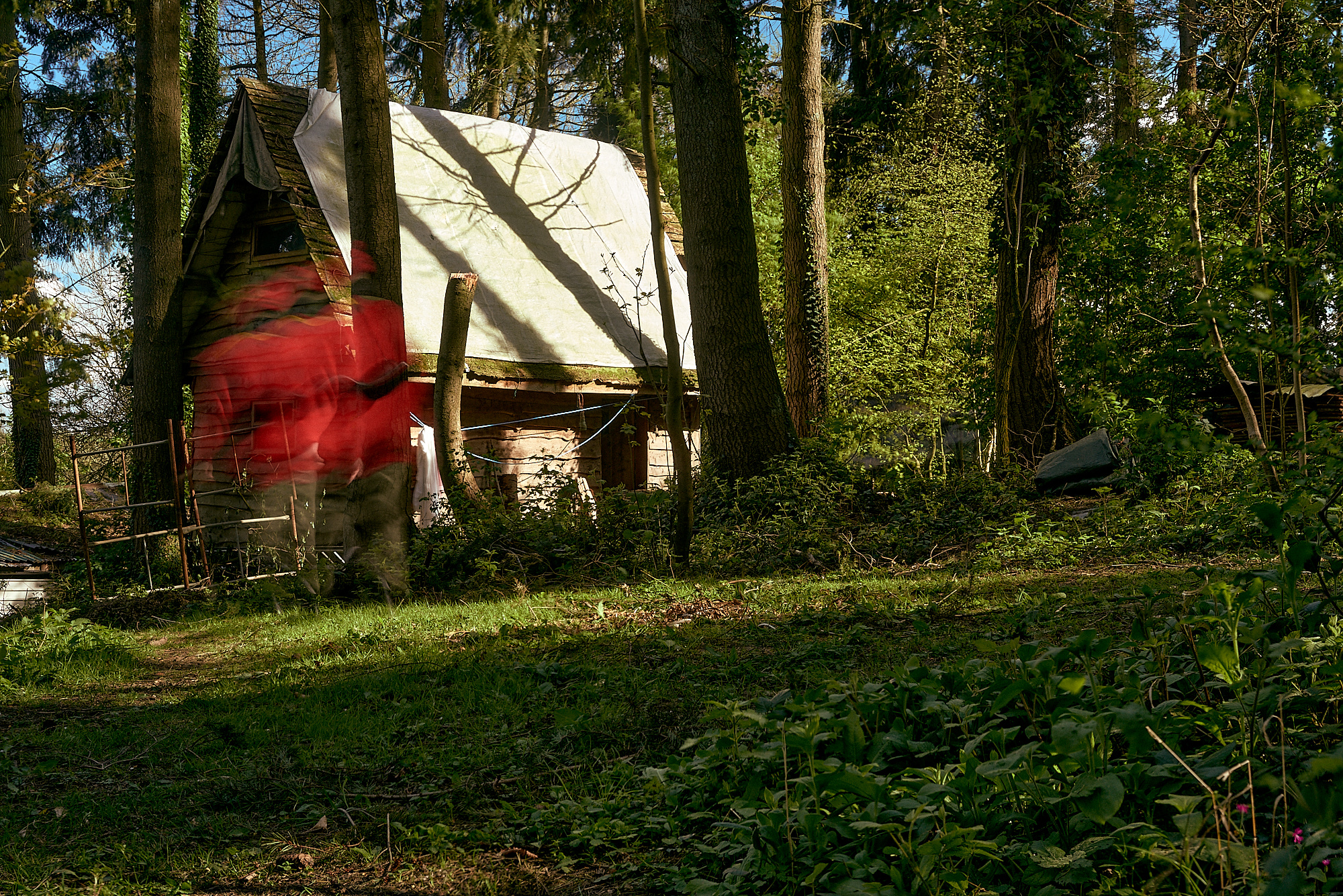
Tinkers Bubble is a small off-grid woodland community that uses environmentally sound methods of working the land without using fossil fuels. The community has planning permission for self-built houses on the condition that they make a living from the land. The buildings are temporary structures built with a very low environmental impact when compared to conventional housing.
Ree, Resident
Over the years the community has tended a range of livestock, including cows, goats, horses, pigs, sheep and poultry. They currently keep horses, chickens and ducks. They grow their own food and manage around 28 acres of woodland, creating their own fuel. Tinkers Bubble produce organic apple juice, cider and cider vinegar which they sell to local shops and at events. They also sell sustainably produced timber which is felled by hand, logged by horse and sawn by a wood-fired steam-engine driven sawmill. The monthly contribution of around £120 for each person covers the community’s shared costs.
The land is held in freehold ownership by a cooperative entitled Tinker’s Bubble Land Ltd. All decisions about the project are made collectively at monthly meetings in which all participate. On rare occasions of dispute, the fully paid-up shareholders (the landholding cooperative) have the power of arbitration or veto. Work meetings once a week help to decide the practicalities of day-to-day land management, community rotas and hosting volunteers.
The planning battle and symbolic significance
The community fought very hard for planning consent for dwellings on the site and now has permission for temporary dwellings with limitations such as to the number of vehicles owned by the community. This battle for planning permission became historically significant: based on struggles to secure planning permission for Tinkers Bubble, Simon Fairlie adopted the term Low Impact Development, which is development which, by virtue of its low or benign environmental impact, may be allowed in locations where conventional development is not permitted. His book “Low Impact Development” (1996) details many principles that are as relevant today as when it was published.
For nearly three decades, the community operated under temporary planning permissions - a precarious legal status that required periodic renewal. After 24 years of temporary planning permission, Tinkers Bubble was granted permanent planning permission in 2023, securing its future for years to come. This was a watershed moment: the community had demonstrated that low-impact, fossil-fuel-free living was not merely ideological but practically sustainable, financially viable, and valued by both local residents and planning authorities.
Governance and philosophy
The community operates on principles of consensus and cooperative ownership. Unlike many co-living communities, which require a degree of affluence to ‘buy in’, Tinkers Bubble doesn’t. “The way we deal with access is getting to know people that might want to live here.” Residents typically enter as volunteers, working on the land for extended periods before becoming long-term residents.
The philosophy unites traditional land management with contemporary concerns about sustainability. Work is done with horses and hand tools, a Victorian apple press and sawmill powered by a vintage steam engine. All show the potential for embracing both traditional and alternative technologies in an effort to move away from reliance on fossil fuels.
The broader significance
Many of those who have lived at Tinkers Bubble have gone on to buy land and set up agroecological land projects. Probably the most well-known is Fivepenny Farm, established when two families, including LWA’s Jyoti Fernandes, bought 43 acres at auction in 2003. The community has become a de facto training ground and inspiration for land-based sustainable living across the UK.
Celebrating its 30th anniversary in January 2024, the village prides itself on being “fossil fuel free” and a pioneer in the UK’s off-grid and intentional community sectors. There are times when they find it challenging - the inevitable irritations of living with other people, or getting up in the dark to tend the animals, or mending a fence in the rain. But the community persists.
Context for this project
Tinkers Bubble represents a sustained, three-decade experiment in living outside the dominant economic and energy systems. Unlike short-term utopian projects, it has endured - through changes in residents, economic pressures, planning uncertainties, and the grinding reality of land-based work. The grant of permanent planning permission in 2023 marks a turning point: the state has formally acknowledged that this model of living works, that it is sustainable, and that it deserves continuance.
The photographs document a place that poses a quiet question: not “what if?” but “what is?” - the lived reality of fossil-fuel-free community, the daily negotiations between collective and individual, between the ideals of 1994 and the facts of 2026. The temporary buildings (designed by principle to be easily removed, to leave minimal trace) have become homes that have sheltered residents for decades. The steam-powered sawmill, the hand-felled timber, the horses, the apple harvest - these are not performance or tourism, but the infrastructure of survival and sustenance.
Sources:
- Tinker’s Bubble, Wikipedia
- Hidden Somerset: Tinkers Bubble - Off-Grid Living Beneath Ham Hill
- Eco-Homes + Communities: Tinkers Bubble, Somerset
- Somerset Daily: Discovering Tinkers Bubble - Somerset’s Hidden Off-Grid Village
- Somerset Daily: Living Off-Grid in Tinkers Bubble
- Positive News: The off-grid community hidden in an English woodland
- Tinkers Bubble official website
- The Land Is Ours: Planning Precedents - Tinker’s Bubble
- Diggers and Dreamers: Tinkers Bubble
- Landworkers Alliance: Celebrating 31 Years of Tinkers Bubble