Cressingham Gardens
THE PLACE AND ITS MAKING
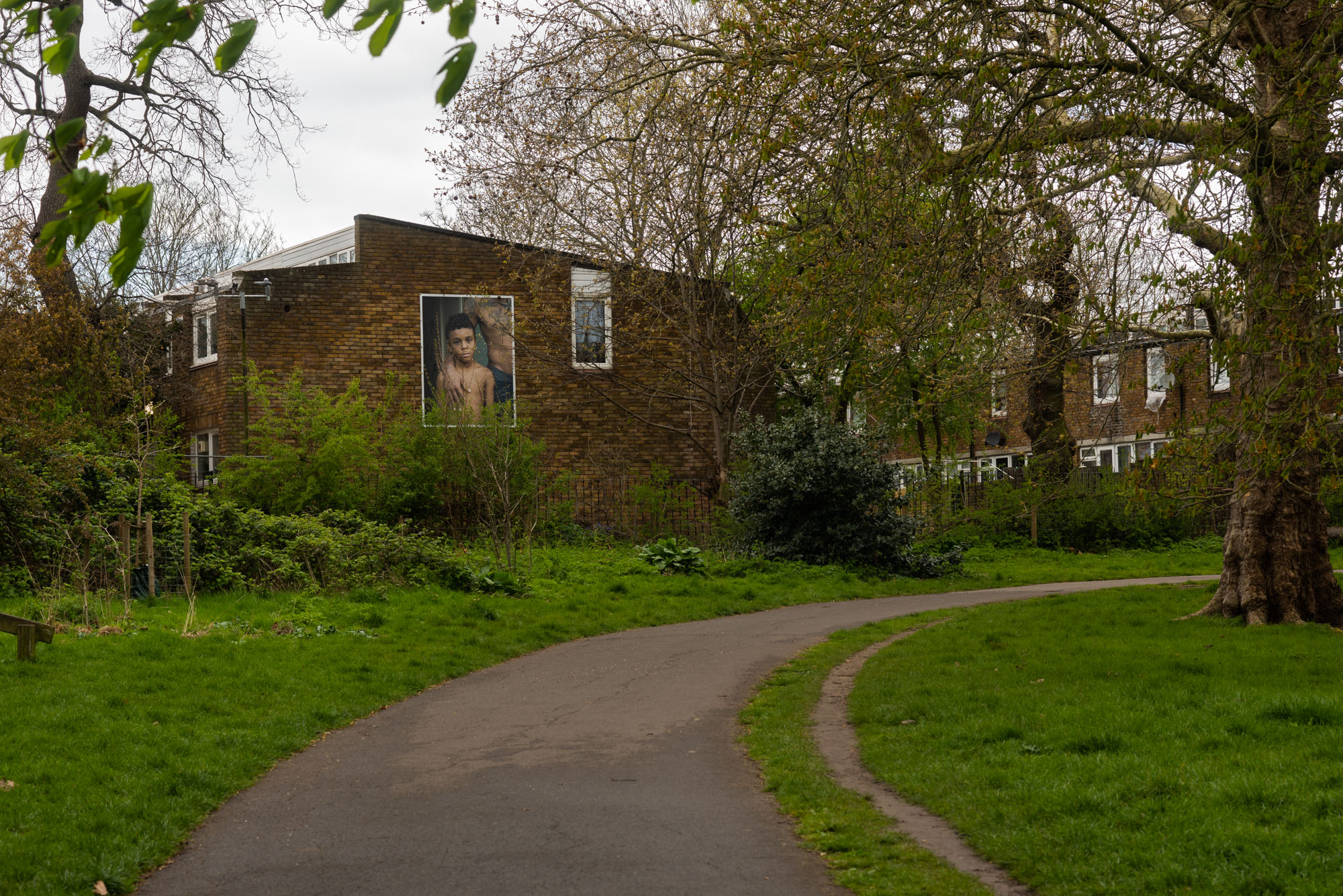
Cressingham Gardens comprises 306 dwellings, a mixture of four, three and two-bedroom houses, and one-bedroom apartments. It was designed at the end of the 1960s by the Lambeth Borough Council Architect Edward Hollamby and second architect Roger Westman, and built at the start of the 1970s. The homes on the estate provide accommodation for households of one to six people, ranging from one bedroom bungalows to four-storey houses, each with its own private outdoor space. The central village green extends the landscape of the park into the site, and buildings are arranged so that the lower ones are around this plateau, rising to four-storey blocks around the perimeter. Cars are kept at the perimeter of the site, with paved access to the housing.
The architects felt that it was very important to create a village-like feel to promote community formation. This was achieved on Cressingham Gardens by the series of pedestrianised walkways, onto which front doors of dwellings all face, located opposite each other. The design features that helped promote the village community feel included a central green space reminiscent of a ‘village square,’ the Rotunda (used for community events, located centrally on the estate), vehicles restricted to the perimeter, small narrow passageways between buildings reminiscent of the ‘unplanned’ feel of medieval villages, and gardens of bungalows typically only fenced in with low picket fences.
THE PHILOSOPHY BEHIND IT
Edward Hollamby rose to the position of the borough’s director of architecture, planning and development from 1969 to 1981, overseeing the construction of several high-rise housing towers alongside an innovative, low-rise development at Cressingham Gardens. Hollamby was a significant figure in the development of post-war social housing. Early influences included the Arts and Crafts movement and William Morris; later influences included the Bauhaus and Modern movement pioneers. These inclined Hollamby towards a view of architecture that was ‘anti-monumental, anti-stylistic and fit for ordinary people.’
Hollamby believed strongly that architecture is ‘a social art’, both in the way it is produced and in the purposes it is required to meet. He saw housing architecture as community architecture, ’embracing the ancillary uses and forms-shops and pubs, old people’s homes, schools, health and community centres, clubs, libraries, and parks-that serve the urban needs of town dwellers.’ The objective was not just to build housing, but to build communities. He believed that the matrix should constantly vary in form and texture, and recognised the preference of most people for ‘fairly small scale, visually comprehensible environments.’
Lambeth’s public housing of the period was conceived in the spirit of the British welfare state. Under Hollamby’s leadership, the council’s building programme grew manyfold in response to the government’s housing drive of the 1960s. Lambeth stands out amongst inner-London boroughs during this period for developing an extensive variety of solutions in its search for high-density housing.
Westman prioritised eco-friendly architecture, and the estate, as a consequence, was planned to retain as many existing trees as possible, and a tongue of landscaping extends from the north of the plateau to Tulse Hill, giving views into the site to passers-by and providing a pedestrian route connecting to the nursery school and then on to Brockwell Park.
Listen to the interview to Elizabeth and Andy, Cressingham Gardens residents
WHY IT MATTERS – THEN AND NOW
The combination of Roger Westman’s urban design innovations in Cressingham Gardens created an architectural model, the Council garden estate, a pedestrianized estate of houses with gardens, in which all the properties are let at council rent levels. As a pioneer of green architecture, Westman wished for more green spaces in London’s mainly concrete social housing projects. This has since become an important model for inner-city housing, as the model allows very high residential densities and has been shown to enable a high quality of life for residents.
Historic England praised the way the design responds to its setting, with skill and sensitivity, “both in the scale and massing of the built elements, as well as through the integration of these elements with informal open spaces which bring a park-like character into the estate.”
THE PRESENT CONDITION AND THREAT
In 2012, Lambeth Council proposed demolishing the estate to replace the terraced houses by apartment blocks. 306 homes are earmarked for demolition on Lambeth’s Cressingham Gardens estate at Brockwell Park. In 2016, Lambeth Council took the decision to demolish the estate based on the fact that refurbishment estimates were £14,000 higher per dwelling than the rest of its estates and this represents ‘poor value for money.’ Lambeth also claims that the redevelopment of the estate will result in the provision of more ‘affordable’ housing to address the housing crisis.
Lambeth Council was forced by the High Court to rerun a consultation on its decision to demolish Cressingham Gardens after a High Court ruling found the council had broken the law by prematurely removing three options relating to refurbishment from a consultation with tenants. Estate resident Eva Bokrosova, who brought the case, said: ‘The council has put me and my neighbours on Cressingham Gardens through absolute agony for three full years since the regeneration was first mentioned.’
In early 2023, Lambeth Council announced that it was pausing the redevelopment of Cressingham Gardens and two other estates (Fenwick and Central Hill) after a critical report recommended a ‘fundamental reset’ to the way it handles the long-running projects. In September 2024, Lambeth published a report highlighting the Council’s plans to reset key estate renewal projects and regain control of properties previously under HfL’s management.
THE ALTERNATIVE
The Cressingham Gardens People’s Plan was a response to Lambeth Council’s 2015 proposals to demolish the estate as part of a borough-wide regeneration programme. The community approached architects to help them understand what alternatives to top-down, demolition-led regeneration might exist. The scheme’s viability was tested in detail and was shown to be deliverable for a fraction of the cost of the demolition-led regeneration using the £1.2M annual rental & service charge receipts to fund the project. This resulted in a more economically, socially & environmentally sustainable solution for Cressingham Gardens which acknowledges the existing community’s right to safe, warm high-quality housing.
CONTEXT FOR THIS PROJECT
Cressingham Gardens represents a critical moment in the history of London housing and urban democracy. Built in the closing decades of a post-war welfare-state philosophy, it embodies a deliberate choice: that council housing should be dignified, spatially generous, and designed to foster community. The estate itself – with its pedestrianised walkways, mixed tenure, and integration with mature landscape – was a utopian vision made concrete in the 1970s.
Today, fifty years later, the estate faces erasure. The question posed by its ongoing fight is not merely architectural or financial, but political: what does a society value when it comes to housing, ownership, and community? The estate’s residents have organised not for heritage preservation, but for survival – and in doing so, they have articulated an alternative future grounded in refurbishment, community ownership, and the principle that council housing can be both economically viable and socially meaningful. The tension between demolition and repair, between displacement and continuity, between profit and stewardship, animates every photograph made here.
Further reading
- Cressingham Gardens, Wikipedia
- Edward Hollamby, Wikipedia
- Architectuul: Cressingham Gardens
- Open House London: Cressingham Gardens
- Municipal Dreams: Building ‘Homes for Tomorrow’: Lambeth’s Council Housing of 1965 to 1980
- The Twentieth Century Society: Cressingham Gardens Estate, Lambeth
- Estate Watch London: Cressingham Gardens Estate
- Variant Office: Cressingham Gardens People’s Plan
- Save Cressingham Gardens campaign
- Building Design: Lambeth set to approve demolition of first part of historic estate