Calder Valley Community Land Trust
Calder Valley Community Land Trust was established in 2014 as a community benefit society with charitable status, working across the Upper Calder Valley - Todmorden, Hebden Bridge, Mytholmroyd. Over 400 members, each holding one non-transferable £1 share. Twelve volunteer trustees, elected by the membership.
Hebden Bridge Town Hall was the first community asset transfer of its kind in the country. That history matters here. The valley already knew how to do this before the CLT existed.
Paul Brannigan on CV CLT
Crown Street, Hebden Bridge
Two council flats in the centre of Hebden Bridge, empty for nine years. Originally tied housing - accommodation that came with certain public sector jobs, a model that has largely disappeared. Both flats are dry, bright and structurally sound. Windows are to be replaced and the properties brought to current thermal and energy efficiency standards. The plan is to bring them back as housing for refugees.
Across the street from the entrance, embedded in the wall: the word COOP. A trace of the cooperative history that shaped this valley.
Ferney Lee, Todmorden
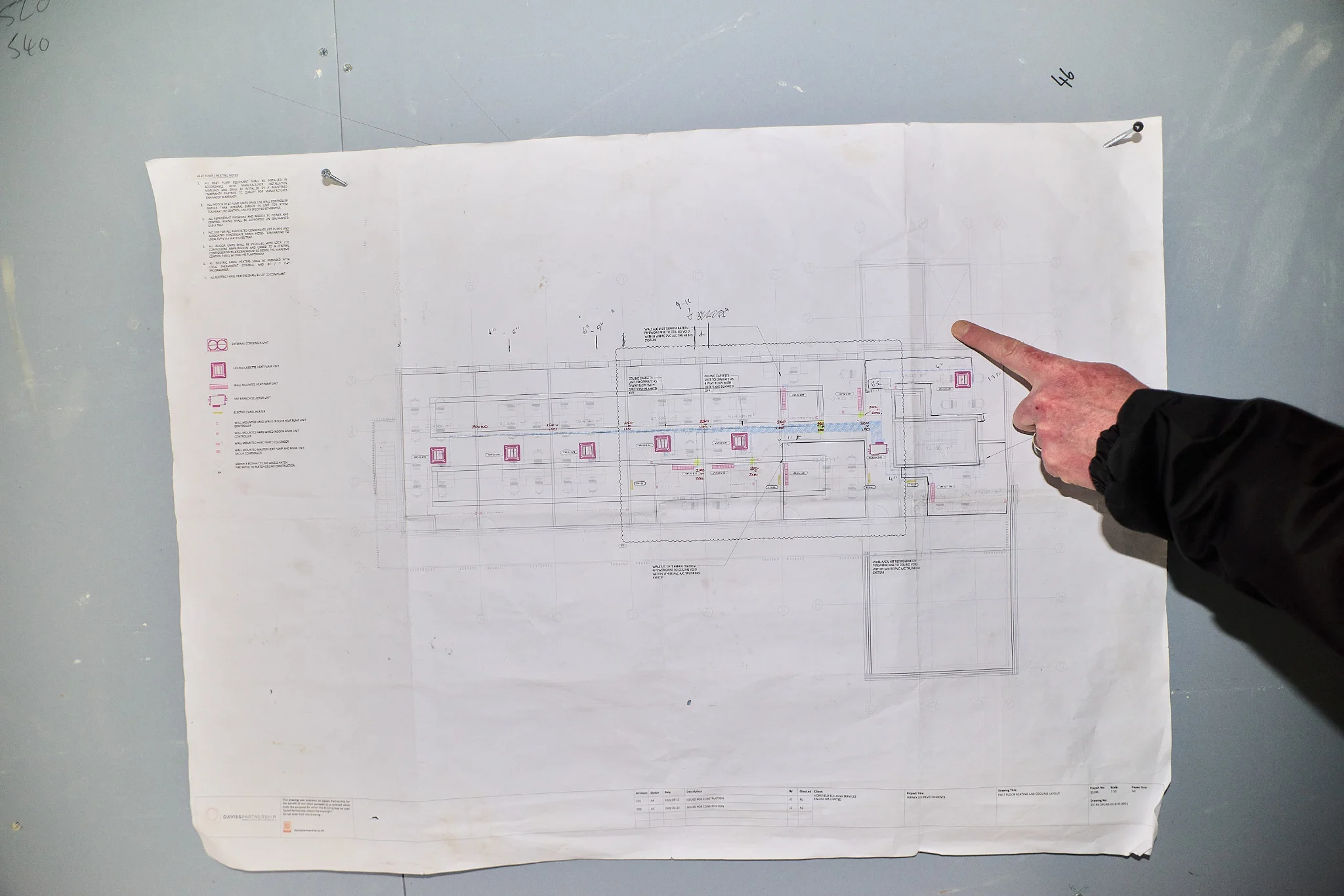
Nineteen homes and twenty-three offices on the site of the former Ferney Lee Home for Older People, part of the £17.5 million Todmorden Town Deal investment programme. Planning permission granted June 2024. Built to the Passive House Institute Low Energy Building Standard: draught-free, whole house mechanical ventilation with heat recovery, very high levels of insulation, solar panels. No air source heat pumps - the insulation and solar do enough that only a light touch of electric heating is needed. Green roofs, power ducted into every parking space ready for more EV chargers to be added in future. Flood water slow-release pipes run the length of the site to reduce stormwater run-off into local watercourses.
Ferney Lee Building Site w/ Paul Brannigan
CVCLT retains ownership of the overall site. CVCLT Enterprise Ltd was set up specifically to build and operate the project - deliberately separate from the CLT, so that if it fails it does not jeopardise the organisation’s housing work. Any operational surplus goes back to the CLT. Homes are developed, owned and managed by CVCLT’s longstanding housing delivery partner Connect Housing, with part funding from Homes England through the UK Government’s Affordable Homes Programme. Connect is a West Yorkshire based charitable housing association and Registered Provider of Social Housing in its own right, and pays a nominal ground rent to the CLT for each home. Lettings via Calderdale’s B-with-us system. The site is managed jointly by CVCLT, TodWorks, and Connect.
The operation is designed for minimal staffing. QR code access throughout: a tenant can hire a meeting room for two hours, enter with a time-limited code, and leave. Twenty of the twenty-three office units have their own front door. Communal kitchen and meeting rooms are available to all. The model pushes against pure hot desking toward co-rented units where small groups share a space with their own autonomy.
Fielden Hall, Todmorden
Fielden Hall w/ Paul Brannigan
Grade II listed former school, built in the nineteenth century by a wealthy local family. Passed through various hands, eventually boarded up. Acquired by CVCLT in 2016 - a listed building with significant repair liability, but one that unlocked residential units and a substantial community space.
The CLT owns the building and charges a small rent to the Fielden Centre Association, a separate charity that operates the hall. The CLT holds the asset; the community organisation runs it.
A £400,000 retrofit: roof insulation, secondary glazing, replacement of the original gas-fired heating. Air source heat pumps now feed radiant heat panels in the main hall. MVHR ventilation recovers heat from outgoing air.
The building has residents in each of the houses that bookend the Hall. They have lived on site for around ten years and are involved in the day-to-day operation.
The hall is in regular use: choir practice, Tai Chi, Women’s Open Talk, dog training, U3A arts and crafts, sound baths, weddings. Music for the Many runs free music lessons from the hall - set up because music education in schools has largely disappeared unless families can pay privately.
Danielle’s House, Hebden Bridge

Danielle's house, Hebden Bridge
CVCLT’s first property in Hebden Bridge: a property purchased from a CLT member at below market cost in April 2024 using Homes England grant funding and a zero percent mortgage from the seller. Refurbished and retrofitted to Decent Homes standard, and let to a local family at a social rent. Danielle is the tenant.
The house sits close to the heart of Hebden Bridge on a site that avoided the 1960s slum clearances. This house is what that ambition looks like when it works at the scale of one family: a secure, affordable, retrofitted home in a town where that combination is rare.
Other projects
CVCLT has taken a lease from Network Rail on the decommissioned Grade II listed Hebden Bridge Signal Box. Renovation and partial conversion to holiday accommodation is due to be completed in 2026.
The former warden’s cottage at Jerusalem Farm - leased from Calderdale Council for 20 years - is now retrofitted and let at an affordable rent to a local family, after years empty and deteriorating.
In partnership with a Todmorden Almshouse charity, CVCLT developed six two-bedroom bungalows for independent living in Walsden. They are let to people aged 65 and over with a strong connection to the local area or a strong need to be there.